




A step and fall incident is a premises liability claim in which the mechanism of injury is a structural surface defect: a pothole, cracked sidewalk, broken curb, or unmarked elevation change, rather than a wet or slick floor. The foot lands abnormally, balance collapses instantly, and the resulting trauma is often severe.
Under Nevada law, liability turns on whether the property owner knew, or through reasonable inspection should have known, that the defect existed and failed to correct it.
Defining the Step and Fall
In Nevada tort law, step-and-fall cases fall within premises liability but are legally distinct from traditional slip-and-fall claims. A slip-and-fall requires proof of a transient surface hazard, such as a spill or a wet floor. A step-and-fall requires proof of a structural property defect that persisted long enough for a reasonable inspection schedule to have found it.
That distinction favors injured claimants: chronic conditions are easier to tie to constructive notice than sudden spills. If you’ve been injured on someone else’s property in Clark County, a Las Vegas slip and fall lawyer can assess whether constructive notice is provable based on your specific facts.
Under NRS Chapter 41, Nevada property owners must maintain reasonably safe premises for all invited visitors. Courts examine inspection logs, prior complaints, and surveillance footage to determine whether the defect was present long enough to establish constructive notice, the core contested element in most slip and fall cases.
Common Causes of Slip and Fall Accidents
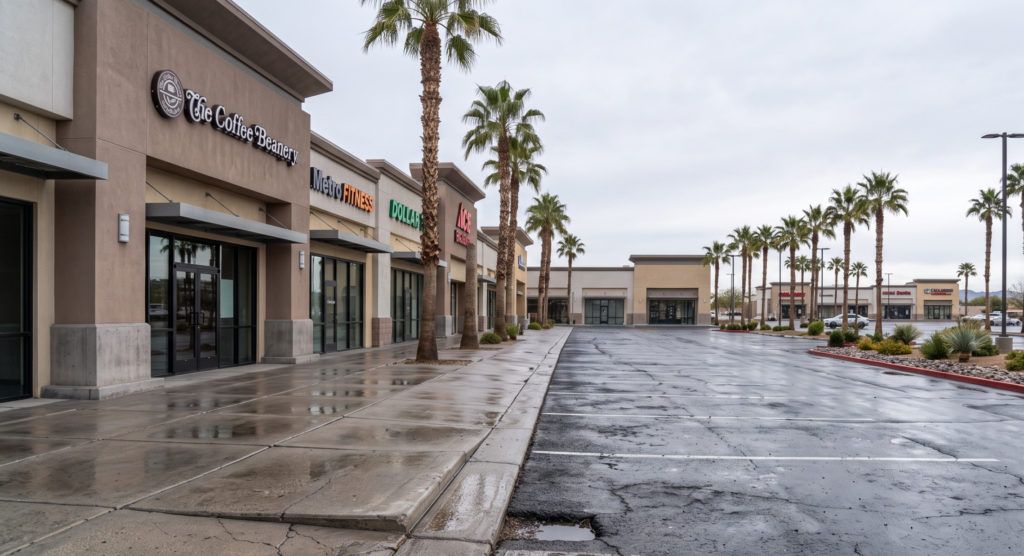
In Las Vegas, the most actionable structural defects follow a consistent pattern:
- Potholes and pavement voids in commercial parking lots where maintenance cycles have lapsed
- Cracked or heaved sidewalk segments with abrupt elevation differences as little as a half inch can catch a shoe
- Unmarked curb drops or step-downs at retail plazas with no paint, tactile strip, or posted warning
- Broken or raised floor tiles inside casinos, hotels, and grocery stores that create a sudden trip surface
- Worn staircase nosing on outdoor staircases and parking garage ramps that obscures the step edge
Why Step and Fall Injuries Are Serious
When a foot drops unexpectedly into a void or catches a raised edge, the entire body weight loads the ankle, knee, hip, or wrist in a single uncontrolled instant. Fractures, not sprains, are the typical outcome.
Primary damages commonly include ankle fractures and ligament tears, knee injuries (meniscus, ACL/MCL), hip fractures especially in adults 55+, wrist and arm fractures from bracing, traumatic brain injury, and spinal compression injuries.
Consequential damages extend further: chronic pain and reduced mobility, loss of future earning capacity, ongoing rehabilitation costs, emotional distress, and diminished quality of life.
Nevada does not cap non-economic damages (pain and suffering) in standard personal injury claims, meaning the full scope of physical and psychological harm is legally compensable.
Proving Liability in Las Vegas
Under established tort law, negligence requires four distinct elements. In premises liability, the duty imposed by statute NRS 41.141 codifies Nevada’s modified comparative negligence framework, under which a property owner who fails to maintain reasonably safe premises has breached that duty the moment an unreasonably dangerous condition goes unaddressed.
These are the evidentiary targets your attorney will build the case around. Under established personal injury law, documented proof of the defect, causation, and harm are the three pillars any successful claim must rest on:
- Photographs and video of the exact defect taken on the day of injury
- Surveillance footage showing how long the condition existed before the fall
- Property maintenance and inspection logs documenting deferred repairs
- Incident report filed with the property manager the same day
- Medical records created within 72 hours linking injuries to the fall
- Prior complaints to the owner or city regarding the same hazard
When the Property Owner Is a Government Entity
Step-and-fall incidents on public sidewalks, roadways, or municipal lots in North Las Vegas and Clark County entail a separate procedural layer.
Claims against government entities under NRS Chapter 41 require a formal Notice of Tort Claim within a compressed window. Sovereign immunity defenses exist but are not absolute; Nevada courts regularly hold municipalities liable for deteriorated sidewalks where a reported defect went unaddressed for an extended period.
If a government entity is potentially liable, contact our firm today before any internal agency deadline passes. Missing those windows can extinguish a valid claim regardless of how strong the underlying evidence is.
Critical deadline: NRS 11.190(4)(e) imposes a hard two-year statute of limitations from the date of injury. Missing it extinguishes your claim entirely regardless of how compelling the evidence is. Do not wait for treatment to conclude before consulting counsel.
Get Legal Help For Your Step and Fall in Las Vegas
Founding attorney Scott Poisson has represented accident victims exclusively since 1993, over three decades without ever switching sides.
Licensed in Nevada, Arizona, New Mexico, and Florida, High Stakes Injury Law knows which Clark County defense tactics insurance carriers deploy on step and fall claims and exactly how to dismantle them. We handle these cases on a contingency-fee basis no fees unless we recover.
If you or a family member suffered a step and fall injury in Las Vegas, evidence degrades and deadlines close fast.
Contact us today for a free consultation: (702) 256-4566.
Disclaimer: This content is for informational purposes only and does not constitute legal advice. No attorney-client relationship is formed by reading this material. Past results do not guarantee a similar outcome in any future case. High Stakes Injury Law is licensed in Nevada, Arizona, New Mexico, and Florida. Scott Poisson, Esq. State Bar of Nevada.