




Personal injury evidence plays a huge role in proving what happened after an accident and protecting your right to compensation. The quality of the medical records, photos, witness statements, and documents you collect can make or break your case.
High Stakes Injury Law brings over 30 years of experience helping Nevada accident victims fight for justice. Their legal team has handled thousands of cases involving complex liability questions.
Proving Liability: Key Takeaways
- Strong evidence helps prove liability and strengthens your accident claim.
- Medical documents, witness accounts, and photos help verify what happened.
- Digital data and financial records make your personal injury evidence more complete.
Medical Records and Expert Testimony
Medical records form the backbone of personal injury evidence because they show the cause, severity, and long-term impact of your injuries. Doctors track everything from imaging results to treatment recommendations and limitations. These details help confirm that the accident directly caused your injuries. The Centers for Disease Control and Prevention reported over 2.6 million emergency department visits for injuries from motor vehicle crashes in 2022 – underscoring the importance of timely care.
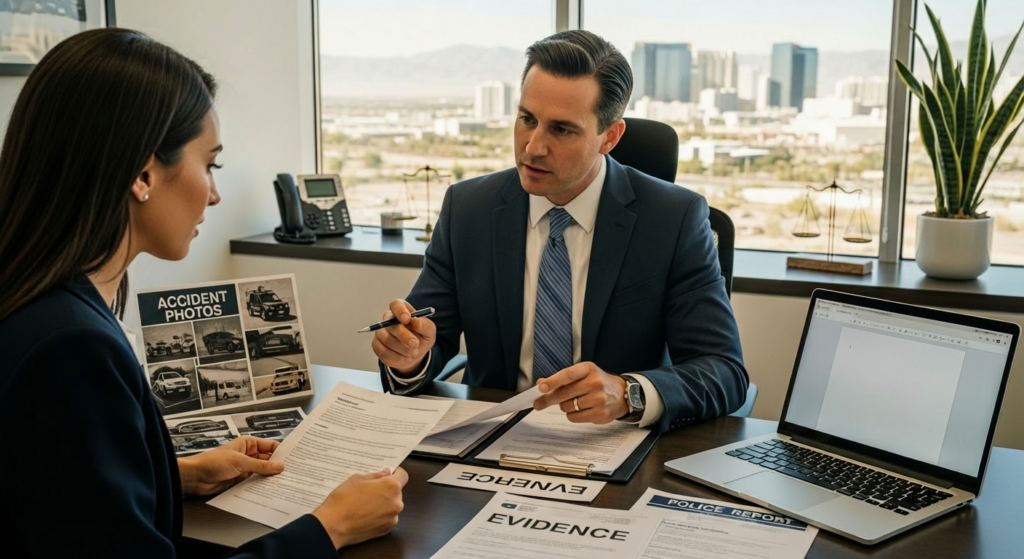
Personal injury evidence in Nevada reviewed by attorney to prove liability and win claim.
Expert medical opinions also help explain complex conditions or future medical needs. If your injury requires surgery, long-term therapy, or lifestyle changes, expert testimony helps prove these damages. Staying consistent with follow-up appointments supports your credibility and reduces the risk of insurers challenging your claim.
Accident Reports and Reconstructions
Accident reports are official documents that help prove liability. Nevada requires crashes involving injury or significant property damage to be reported, and the Nevada DMV outlines these rules clearly. These reports often include diagrams, road conditions, witness details, and officer observations.
If fault is disputed, crash reconstruction specialists may analyze skid marks, vehicle damage, and roadway data to reconstruct the crash. The National Highway Traffic Safety Administration provides detailed research on crash reconstruction methods, which are widely used nationwide. Their data helps clarify impact speed, vehicle movement, and crash sequence.
Witness Testimony and Video Surveillance
Witnesses can verify what they saw, offering unbiased accounts that help support accident claim evidence. Their statements can confirm traffic light colors, driving behavior, or the direction of impact. Eyewitness testimony can help fill gaps when physical evidence is limited.
Video footage can be even more powerful. Dashcams, business security cameras, and traffic cameras often capture collisions in busy areas of Nevada. These videos make it harder for insurers to dispute what happened, as they clearly show the events.
Financial Documentation for Damages
A personal injury claim includes more than medical bills. Wage loss, reduced earning capacity, repair costs, and out-of-pocket expenses all matter. Keeping every receipt helps show the real financial effect of the accident.
These documents help calculate both current and future damages. Even small costs, like over-the-counter medications or transportation to appointments, add to your total compensation.
Digital Evidence from Phones and Vehicle Tech
Smartphones and modern vehicles store valuable evidence for accident claims. Photos, videos, timestamps, and location data help verify your story. If distracted driving played a role, phone activity logs may provide proof.
Many cars include Electronic Data Recorders that track speed, braking, and steering before impact. This data can support proving liability when the other driver denies fault. EDR information is often used in disputed collision cases.
Photographs and Scene Documentation
Photos taken at the scene help create a visual timeline of what happened. Capture vehicle damage, skid marks, the location of traffic signals, weather conditions, and injuries. These images help insurers and attorneys understand the scene and the force of impact.
Clear photos also help prevent false accusations about damage or injury exaggeration. They offer objective proof, making your case stronger.
Timeline Consistency and Post-Accident Behavior
Your behavior after an accident affects your credibility. If you delay medical care or give inconsistent statements, insurers may argue that your injuries are unrelated. The Cleveland Clinic emphasizes that accurate medical timelines support reliable diagnoses and treatment plans.
Following your doctor’s instructions and documenting symptoms helps maintain a clear, consistent record.
Role of Legal Teams in Preserving Evidence
A skilled injury lawyer plays a major role in gathering and protecting personal injury evidence. Attorneys send preservation letters to prevent companies from deleting videos or digital records. They also interview witnesses, collect expert opinions, and manage important deadlines.
The American Bar Association recommends proper evidence preservation practices to ensure materials are usable in court. An experienced legal team makes sure no critical detail is overlooked.
Your Next Step
If you were injured in an accident and need help gathering the right evidence, our personal injury team is ready to guide you. Contact High Stakes Injury Law today to get personalized legal support.
Accident Claim Evidence: Bottom Line
Strong accident claim evidence increases your chance of winning full compensation. When your documents, testimony, and digital proof line up, insurers have fewer ways to challenge your case. With the right legal support, this evidence becomes a powerful foundation for a successful claim.
Personal Injury Evidence: FAQ
Many Nevada accident victims have frequently asked questions about personal injury evidence and how to protect their rights. Here are the answers to the most common ones.
- What evidence matters most in a personal injury case?
Medical records, photos, witness statements, and digital data are some of the strongest forms of personal injury evidence. These items work together to show what happened and how it affected you. - How long should I keep my medical records after an accident?
Keep them until your claim is fully closed. It’s smart to store digital copies in case questions come up later. - Do I need expert witnesses to prove liability?
Not always, but experts can help in cases with serious injuries or unclear fault. Their professional insight adds weight to your accident claim evidence. - What if no one witnessed my accident?
You can still prove liability using videos, police reports, digital data, and scene photos. Many strong cases are won without eyewitnesses. - Can phone or vehicle data help my case?
Yes. Photos, timestamps, and EDR information help verify your version of events and challenge inaccurate claims from insurers.
About Our Firm
Attorney Scott Poisson, founder of High Stakes Injury Law, has represented accident victims since 1993 and is licensed in Nevada, Arizona, New Mexico, and Florida.
Learn more about our law firm, to see how we work and how we can help you protect your legal rights and obtain compensation.