



Yes, a driver can challenge a police report in a Nevada car accident, but it takes more than simply disagreeing with what the officer wrote.
A police report is an officer’s documented observations made at the scene, not a legal verdict. It can contain errors, omissions, or incomplete accounts. If it doesn’t accurately reflect what happened, you have the right to dispute it.
That said, a meaningful challenge requires evidence, documentation, and in most cases, the guidance of an experienced Nevada car accident lawyer who understands how these disputes play out with insurers and in court.
The Role of Police Reports in Car Accidents
Importance of Accurate Reporting
When officers respond to a crash in Nevada, they prepare a report summarizing their observations, including party information, a description of how the accident occurred, any violations noted, and a preliminary fault assessment. Insurance companies, opposing attorneys, and courts frequently treat this document as a key reference point.
However, officers often arrive after the fact, reconstruct an event they didn’t witness in a stressful environment, and do so based on limited information.
That’s why errors happen, and why challenging a report, when warranted, is both legitimate and sometimes necessary.
Impact on Insurance Claims
Nevada follows a modified comparative negligence rule under NRS 41.141, which means that if you’re found to be 51% or more at fault, you may be barred from recovering compensation entirely.
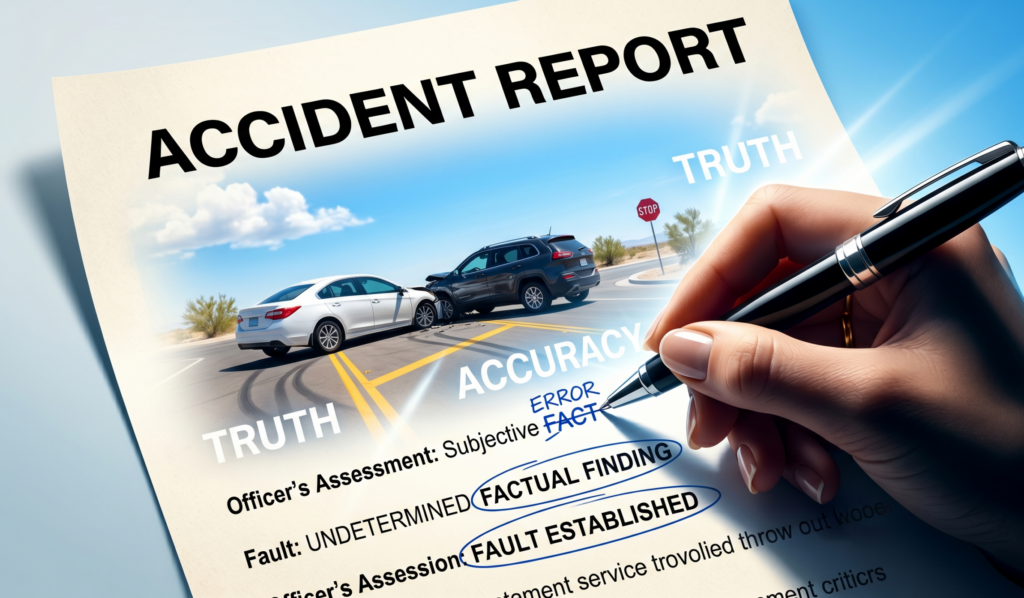
Hand-correcting a car accident police report with a pen to establish truth and factual accuracy in Nevada.
Even partial fault attribution can reduce what you receive. An inaccurate police report that assigns blame incorrectly isn’t just frustrating; it can have real financial consequences for your claim.
Legal Rights After a Car Accident in Nevada
Nevada Car Accident Law – Key Points
Under NRS 484E.030, drivers must report accidents involving injury, death, or significant property damage to law enforcement. However, an officer’s fault conclusions are not admissible as proof of liability in civil court.
Disputing a Police Report
You can request corrections for objective errors, submit a written rebuttal (attached to the official record), or work with an attorney to raise inaccuracies during negotiations.
While you can’t force an officer to change their subjective assessment of fault, a documented counter-narrative carries real weight in insurance disputes and civil proceedings.
Steps to Challenge a Police Report
Gather Supporting Evidence
Before filing any formal challenge, build your evidentiary foundation:
- Photos and videos of vehicle positions, road conditions, traffic signals, and damage
- Dashcam or nearby surveillance footage
- Medical records consistent with your account of the crash
- Your own written statement, drafted as soon as possible after the accident
- Physical evidence, such as skid marks or debris patterns
Filing a Formal Challenge
- Obtain a copy of the report from the responding agency, such as the Nevada Highway Patrol or a local police department.
- Identify specific factual inaccuracies rather than subjective disagreements.
- Contact the reporting agency to request corrections on clear factual errors.
- Submit a written rebuttal with your version of events and supporting documentation.
- Consult a Nevada car accident attorney before submitting anything in writing that could affect your legal claim.
Role of Witnesses and Statements
Independent witness accounts can meaningfully shift a disputed narrative.
Reach out to witnesses as early as possible; memories fade quickly.
A signed statement or willingness to speak with an attorney can carry significant weight during insurance negotiations and in legal proceedings.
When to Consult a Nevada Car Accident Lawyer
Situations Requiring Legal Expertise
Consider consulting a Nevada car accident lawyer if:
- The report incorrectly assigns fault to you, affecting your ability to recover compensation
- You’ve suffered significant injuries, and the inaccurate report could minimize your damages
- The insurance company is relying on the report to deny or undervalue your claim
- There are conflicting accounts with limited physical evidence to resolve them
Benefits of Legal Representation
An experienced attorney brings evidence-gathering expertise, negotiation leverage with insurers, and knowledge of Nevada-specific laws, including the comparative fault rules that directly affect your recovery. Getting legal guidance early, before you’ve submitted written statements or signed documents, can help you avoid costly missteps.
Resources and Next Steps
Legal Resources in Nevada
- Nevada Highway Patrol handles accidents on state highways, handles report requests, and correction inquiries
- Nevada DMV for driver records and licensing matters related to your accident
- Legal Aid Center of Southern Nevada (LACSN) For those seeking general legal guidance (Note: LACSN serves Clark County and surrounding areas; confirm eligibility before contacting)
Post-Accident Checklist for Nevada Drivers
- [ ] Ensure safety and call 911 if there are injuries
- [ ] Avoid recorded statements to insurers before consulting an attorney
- [ ] Note the responding officer’s name and badge number
- [ ] Document the scene with photos and video before vehicles are moved
- [ ] Collect witness contact information
- [ ] Obtain and carefully review the police report for errors
- [ ] Write your own detailed account as soon as possible
- [ ] Contact a Nevada car accident lawyer if fault is disputed or the report appears inaccurate
Protect Your Rights After a Nevada Car Accident
If something in the police report doesn’t reflect what actually happened, don’t wait. The sooner you act, the stronger your position.
Call (702) 605–6671, or contact High Stakes Injury Law online, for a free consultation – no cost, no obligation.
About High Stakes Injury Law
High Stakes Injury Law is a premier personal injury firm dedicated to fighting for victims of negligence. Founder Scott Poisson has exclusively represented accident victims since 1993, bringing over three decades of expert legal advocacy to clients across Nevada, Arizona, New Mexico, and Florida. Our team understands the local courts and the tactics insurance companies use to minimize your claim.
Learn more about our firm, or contact us today for a free consultation.