




A routine visit to a local business or a friend’s home can turn into a disaster in an instant when a hidden hazard leads to a fall. In these moments, the concept of property negligence becomes the center of your recovery process. Nevada law requires property owners and managers to maintain a safe environment for everyone who enters the property. When they ignore basic safety standards, they are often legally responsible for the medical bills and suffering that follow.
At High Stakes Injury Law, our premises liability lawyers understand that a serious injury is about more than just physical pain; it is a threat to your financial security and future. Our legal team uses decades of local experience to hold negligent parties accountable for the dangerous conditions they permit.
Property Negligence: Key Takeaways
- Property owners must actively fix hazards or provide clear warnings to avoid liability.
- Nevada uses a modified comparative negligence rule that allows you to collect money even if you were partially at fault.
- The strength of your claim depends on gathering evidence of the injury, such as photos and witness statements, immediately.
Understanding Property Negligence in Nevada
Property negligence is the failure to use reasonable care to keep a building or land safe for others. In Nevada, this means that owners cannot simply wait for an accident to happen; they have an ongoing duty to act.
Key Elements Involved
To build a successful case, you must show that the owner had control over the property and that a dangerous condition was present. You must also prove that the owner knew about the danger or should have known through regular inspections.
Duty of Care
A duty of care is the legal requirement to act in a way that prevents foreseeable harm. According to the National Safety Council, falls are a leading cause of non-fatal injuries treated in emergency departments. This duty is especially high for businesses that invite the public onto their premises.
Breach of Duty
A breach occurs when an owner ignores a broken stair, a dark hallway, or a slippery floor. If a reasonable person would have fixed the problem, the law considers the owner’s inaction a breach of their duty to keep you safe.
The Role of Owner Liability
Owner liability is the legal obligation for a property manager or landlord to pay for damages caused by their neglect. This applies whether the accident happened at a Las Vegas casino, a grocery store, or an apartment complex.
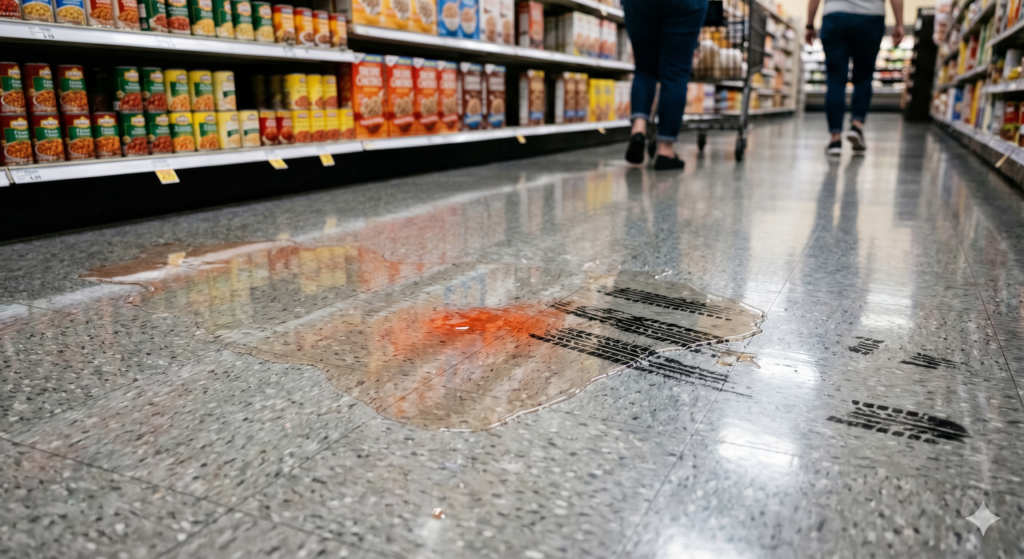
Close-up of a major liquid spill on a busy grocery store aisle with no yellow “Wet Floor” sign nearby, symbolizing a hidden hazard in Nevada.
Responsibilities of Property Owners
Owners must perform regular safety sweeps to catch new hazards. In commercial settings, this often means checking high-traffic areas every hour to ensure no spills have occurred.
When Owner Liability Comes into Play
Liability applies when an owner has “notice” of a danger. If a store employee sees a spill but walks away to help a customer, the store is liable. Liability also exists if a hazard, like a rotting balcony railing, was present long enough that a routine check should have found it.
Common Hazards Leading to Premises Liability Injuries
Unsafe premises can involve anything from a loose rug to a major structural defect. Identifying the exact cause of your injury is the first step in proving your case.
Commercial Property Hazards
In a busy city like Las Vegas, commercial hazards are common. Data from the CDC shows that one in five falls results in a serious injury, such as a head trauma or broken bone. Wet floors in hotels and uneven pavement in parking lots can contribute to these statistics.
Public Space Challenges
Public parks and government buildings must also meet safety standards. However, filing a claim against the government involves different rules and much shorter deadlines. It is vital to identify who owns the land immediately after your accident.
What to Do After an Injury Occurs
The actions you take in the first hour after an accident are the most important for your future claim. You need to create a clear record of what happened before the property owner can fix the hazard.
Documenting Injury Evidence
Take clear photos of the hazard from several different angles. If there is a spill, show if there are tracks through it or if it has started to dry at the edges. This proves the hazard was there for a while. Collect the names and contact information of anyone who saw the event.
Reporting the Incident
Notify the manager or owner and ask for a written report. Do not leave without a copy or a reference number for the report. Also, seek medical help right away. Your medical records are the best proof of the physical harm you suffered.
Proving Negligence in Court
If an insurance company refuses to pay a fair amount, your case may go to court. This is where your legal team presents the facts to a judge or jury.
Comparative Negligence Considerations
Nevada follows a modified comparative negligence rule under Nevada Revised Statutes section 41.141. This means you can still recover money even if you were 50% at fault for the accident. Your final award is simply reduced by your percentage of responsibility.
Statute of Limitations for Filing Claims
In Nevada, you generally have two years from the date of the injury to file a lawsuit under Nevada Revised Statutes section 11.190. If you miss this deadline, you will lose the right to seek any compensation. Acting quickly also prevents the property owner from deleting security footage that could prove your case.
Contact High Stakes Injury Law Today
If you have been hurt because a property owner was careless, do not handle the insurance company alone.
Contact High Stakes Injury Law today for a free virtual consultation to review your legal options.
Our team is here to fight for your rights and the money you need to heal.
Owner Liability: Bottom Line
Proving owner liability is the only way to hold a reckless business or landlord accountable for your pain. When you have the right evidence and a professional legal team, you can protect your family’s financial future. We are dedicated to ensuring that every client gets the support they deserve during their recovery.
Property Negligence: FAQ
Many people have questions about how a property negligence claim works in the real world. Here are the five most common questions we hear from victims.
What if the property owner did not know about the hazard?
Owners are responsible for the hazards they should have discovered. If a leak is ignored for days, the owner is liable for failing to inspect their property.
How does unsafe property affect my claim?
The environmental hazard is proof of the owner’s neglect. A very dangerous area with many code violations often leads to a higher settlement.
Can I still pursue a claim if I was partially at fault?
Yes. As long as you are not more than 50% at fault, you can still collect damages in Nevada.
What if I were injured at an apartment complex?
Landlords are responsible for common areas like stairs, gyms, and parking lots. If these are not maintained, the landlord is liable for your injuries.
How much does it cost to start a case?
Most injury law firms work on a contingency basis. This means you pay nothing up front, and we only get paid if we win money for you.
About Our Law Firm
High Stakes Injury Law stands as a premier Las Vegas practice dedicated to securing justice for accident victims across Nevada.
With a legacy of over 40 years of service, the firm has successfully recovered more than $500 million for clients, including landmark $9 million settlements in complex motor vehicle cases.
Our law office is headquartered at 320 S Jones Blvd, Las Vegas, NV 89107. Our practice combines aggressive courtroom litigation with compassionate support to help families navigate their most challenging moments. Learn more about our record of results and dedication to the community on our About Us page.