



If you have been involved in a collision with a commercial semi-truck, you are entering a high-stakes legal battle where your trucking accident claims face a billion-dollar industry. Within hours of a crash, trucking companies often deploy “Rapid Response Teams.” These investigators and lawyers work only to protect corporate assets before you even leave the hospital.
At High Stakes Injury Law, we understand the immense pressure you feel when facing these massive corporations. Our founder, Scott Poisson, has exclusively represented accident victims since 1993 and is licensed in Nevada, Arizona, New Mexico, and Florida. He brings over three decades of experience to every case we handle. This ensures your rights are protected against aggressive corporate defense tactics. Contact us today for immediate legal help: (702)-256-4566
The answer to what they are hiding is simple. They are hiding evidence. Trucking companies hold the black box data, dashcam footage, and driver logs that prove they are liable. They may legally destroy this data if you do not act immediately. To win, you must secure a spoliation letter. This legal document “freezes” these records before they are deleted in the normal course of business.
Trucking Insurance: Key Takeaways
- Carriers often use layered trucking insurance policies that can cover up to $ 5 million or more to protect their bottom line.
- Evidence such as Electronic Logging Device (ELD) data is frequently overwritten after six months without a formal legal hold.
- Insurance adjusters often push for a quick settlement to prevent victims from discovering the full extent of their long-term damages.
Understanding Truck Accident Liability
Truck accidents are rarely as simple as one driver hitting another. Commercial vehicles are part of a complex supply chain. Multiple parties, like the carrier, the maintenance provider, or even the manufacturer, may be responsible for your injuries and your trucking accident claims.
The Basics of Truck Accident Liability
In Nevada, liability is grounded in negligence. The process is governed by state laws, such as Nevada Revised Statute, Chapter 41.141. This modified comparative negligence rule allows you to recover damages as long as you are not more than 50% at fault for the collision. If a jury finds you 20% at fault, your final award is reduced by that same 20%.
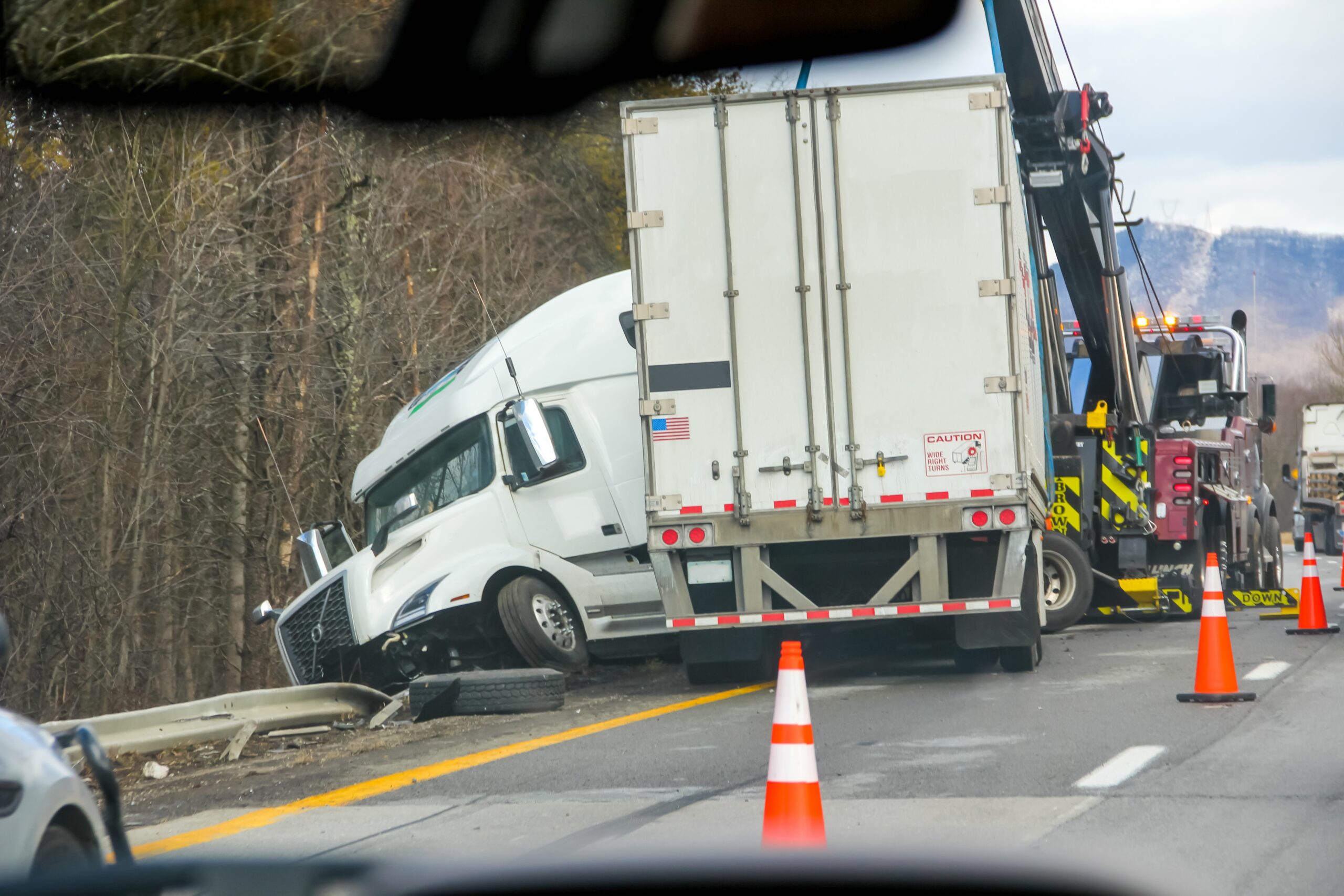
Large truck involved in a highway accident
Corporate Negligence in Trucking Accidents
An employer is generally responsible for their employees’ actions. A carrier’s liability often stems from “negligent hiring” or failing to properly vet a driver’s past safety violations. This means the company is directly responsible for putting an unsafe driver on the road.
Common Causes of Truck Accidents
The Federal Motor Carrier Safety Administration (FMCSA) reports that “critical reasons” for crashes often involve the truck running out of its travel lane. According to NHTSA data, fatalities in crashes involving at least one large truck decreased significantly in early 2025. Still, the impact remains catastrophic due to the massive vehicle weight.
Trucking Insurance Insights
Commercial trucking insurance protects the assets of massive corporations. It is not meant to provide you with a fair recovery. Navigating these policies requires an understanding of how carriers shield themselves from high-value payouts.
Types of Coverage Trucking Companies Use
Most trucking companies carry primary liability insurance. Many also use “excess” or umbrella policies to cover catastrophic losses. Some negligent carriers even act as “chameleon carriers.” They dissolve their business after an accident and reopen under a new DOT number to hide their safety record.
Understanding the Claims Process with Insurance Providers
The insurance adjuster is a professional negotiator. Their goal is to save the company money. They may seem helpful or even friendly. However, they often use the initial shock of the accident to get you to sign away your right to sue for emotional distress or future medical care.
Truck Driver Fatigue and Its Impact on Liability
Truck driver fatigue is a silent killer on the road. It contributes to a significant portion of all large truck crashes. When a driver is exhausted, their reaction time is impaired just as much as if they were driving under the influence of alcohol.
Recognizing the Signs of Driver Fatigue
A fatigued driver often leaves no skid marks at the scene. This happens because they never hit the brakes before the impact. Accidents occurring between 1:00 AM and 6:00 AM are high-risk indicators of fatigue. This is the body’s natural circadian dip where alertness is lowest.
Legal Implications of Fatigued Driving
The FMCSA Hours-of-Service (HOS) regulations are strict. They generally limit property-carrying drivers to 11 hours of driving after 10 consecutive hours off. If we prove a driver violated these federal rules, the trucking company can be held liable for negligence.
Cargo Laws and Their Importance
Sometimes the accident is not caused by the driver’s steering. It is caused by the weight behind them. Federal cargo laws dictate exactly how freight must be secured. This prevents life-threatening shifts during transport.
Regulations Surrounding Cargo Load and Safety
Federal rules require drivers to inspect their load within the first 50 miles of a trip. They must re-examine it every 150 miles or three hours of driving to ensure it has not shifted.
Liability for Improperly Loaded Cargo
A third-party shipping company might have loaded the truck incorrectly. In that case, they may share liability for the accident. This adds a layer of complexity to liability disputes. The carrier and the loader will often point fingers at each other to avoid paying the victim.
Navigating Liability Disputes
In the aftermath of a crash, the trucking company will likely launch a defense immediately. Liability disputes are common. The carrier may try to blame the victim or external factors to protect its profits.
Common Disputes in Truck Accident Claims
Carriers frequently argue that their drivers are “independent contractors” rather than employees. This is a common legal tactic. It is used to distance the company from the driver’s negligence. It also limits the victim’s access to the company’s larger insurance policies.
How to Protect Your Rights in These Situations
The most effective way to fight back is through thorough injury documentation. You also need a “spoliation letter.” This legal document forces the trucking company to preserve the truck’s black box (ECM). It also protects dashcam footage, which provides objective evidence of the crash.
Claim Process Insights
The path to recovery involves more than just filing a police report. You must follow a systematic process. This ensures your trucking accident claims are not undervalued by the defense during negotiations.
Steps to Take Immediately After an Accident
First, prioritize medical care. This creates an official record of your injuries. Next, capture photos of the truck’s DOT number and the license plate. These are essential for identifying the correct corporate entities involved in your case.
Working with Attorneys to Maximize Your Claim
A specialized attorney uses accident reconstructionists to prove how the crash occurred. We work to quantify non-economic damages. This ensures you are compensated for the trauma, pain, and life changes that a standard insurance check will never cover.
Contact Us: High Stakes Injury Law
If you or a loved one has been injured, you don’t have to face the trucking companies alone.
Contact High Stakes Injury Law today for a free virtual or in-person consultation: (702)-256-4566
We can start preserving the evidence you need to win.
Cargo Laws: Bottom Line
Understanding cargo laws and federal safety standards is the key to uncovering corporate negligence. When you hold these companies accountable, you get the compensation you deserve. You also help make the roads safer for everyone.
Trucking Accident Claims: FAQ
If you have been involved in a collision, you likely have many questions about trucking accident claims and the legal process.
- How long do I have to file a claim in Nevada? Generally, you have two years from the date of the accident under NRS 11.190. However, evidence such as driver logs can be destroyed in as little as 6 months.
- What if the trucking company says the driver was a contractor? We investigate the extent of the company’s control over the driver. Often, they are still legally liable despite the “contractor” label.
- Can I still recover if I was partially at fault? Yes. Under Nevada’s modified comparative negligence law, you can recover if you were 50% or less at fault for the crash.
- What is a “black box” in a semi-truck? It is an Electronic Control Module (ECM). It records speed, braking, and throttle position at the moment of impact.
- Why shouldn’t I accept the first settlement offer? Initial offers rarely account for long-term medical needs. They also often ignore the full extent of your emotional distress following the trauma.
About Our Law Firm
High Stakes Injury Law stands as a pillar of strength for the injured, built on a foundation of elite advocacy and record-breaking commitment. The firm was founded by Scott Poisson, who has exclusively championed the rights of accident victims since 1993 across Nevada, Arizona, New Mexico, and Florida. It has grown into a powerhouse legal team recognized for its formidable presence in complex litigation. Our firm provides high-level advocacy for those in Las Vegas, Paradise, and throughout Nevada who have suffered life-changing injuries.