




In Nevada, medical records are the definitive legal evidence that links your injuries to an accident. They prove the existence of harm, establish a timeline for insurance adjusters, and quantify the financial necessity of treatment.
Under Nevada’s modified comparative negligence laws, these records are the primary tool used to ensure you are fairly compensated for medical expenses and pain and suffering.
Key Takeaways:
- No Documentation = No Injury: If it isn’t in your records, insurance companies may argue it didn’t happen.
- The 51% Rule: In Nevada, you must be less than 51% at fault to recover damages; medical records help prove that the accident, not a pre-existing condition, caused your pain.
- Timeliness is Vital: Gaps in treatment can significantly reduce the value of your settlement.
Importance of Medical Records in Injury Claims
Medical records act as the objective “witnesses” to your physical and emotional recovery. In the legal world, your personal account is vital, but your medical records are the definitive proof. By quantifying damages through ER visits, surgical reports, and rehabilitation notes, these records ensure that any settlement offer reflects the true extent of your losses.
Overview of Nevada Personal Injury Laws
Nevada operates under a modified comparative negligence system (NRS section 41.141). This means you are eligible to recover damages as long as you are found to be 50% or less at fault for the accident.
Medical records are essential here because they help distinguish between new trauma and pre-existing conditions. Under Nevada law, if an accident aggravates a previous injury, you could be entitled to compensation for the additional harm caused, but only if your records clearly document that change.
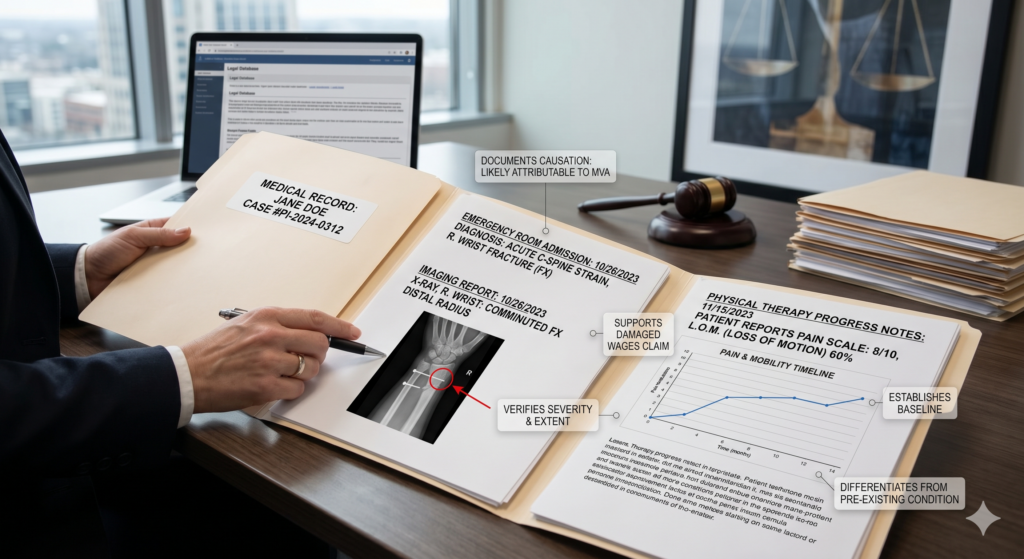
A photo showing medical records and X-rays being analyzed by an attorney in a legal office as evidence for an injury claim.
The Role of Medical Records in Establishing Claims
Proof of Injury
The burden of proof rests on you, the claimant. If you experience neck pain after a collision, a diagnostic scan (like an X-ray or MRI) can act as scientific proof. Often, adrenaline masks pain initially; records from a follow-up visit showing internal inflammation or soft tissue damage can be critical for securing long-term care coverage.
Diagnoses: Accuracy and Timeliness
An immediate diagnosis can prevent insurance adjusters from claiming your injuries happened after the accident. Seeking care at local facilities like University Medical Center (UMC) or Sunrise Hospital helps create a “day-one” record that is difficult for the defense to dispute.
Treatment Timelines: Documenting the Healing Process
Your medical records should tell a story of consistent effort toward recovery.
Consistent records from initial triage to final physical therapy can show that your injuries required sustained professional intervention, which may validate the “pain and suffering” component of your demand.
Navigating the Medical Records Retrieval Process
Understanding Medical Record Requests
Retrieving records isn’t just about obtaining a bill; it’s about securing the health provider’s notes. These notes can include details about your physical limitations, such as the inability to lift a child or difficulty sleeping, that may humanize your case for a jury.
Ensuring Compliance with HIPAA Regulations
The federal HIPAA Privacy Rule gives you the right to access your records, while Nevada’s NRS section 629.061 ensures providers must provide copies of your records (usually within 30 days) to you or your representative.
Tips for Efficient Retrieval
- Keep a Facility Log: Track every clinic, specialist, and imaging center.
- Request “Certified” Copies: Certified records are often required to be admissible as evidence in a Nevada court.
- Act Quickly: Per NRS section 629.051, most Nevada providers are only required to retain records for 5 years after their last production or receipt.
Legal Implications of Medical Records in Claims
Claim Evidence: The Weight of Documentation
A physician’s observation that a patient’s range of motion is limited by a specific percentage could be used as a legal fact – to calculate lost earning capacity and lifestyle impact.
Common Claim Denial Reasons Related to Medical Records
Insurance companies look for “red flags” to minimize payouts:
- Pre-existing Conditions: Arguing that your injury is an old issue.
- Inconsistent Statements: Telling a nurse you “feel better” while telling an insurance adjuster you are in severe pain.
- Non-Compliance: Missing physical therapy appointments, which can suggest the injury isn’t serious.
Medical Negligence Cases: When Records Become Critical
In medical malpractice suits, the record is a part of the evidence log. Every timestamp and dosage becomes proof of whether the care met Nevada’s established medical standards.
Summary
Why Records Matter in Personal Injury Claims
Medical records can be a bridge between your accident and your financial recovery. They satisfy insurance algorithms and meet Nevada court requirements while honoring your journey toward healing.
Final Thoughts on Organizing Evidence for Success
From a legal perspective, “Special Damages” (bills) can be the foundation, but “General Damages” (impact on life) can be the heart of a claim.
Documenting how you can’t walk your dog in a Summerlin park or commute on the 215 Beltway can make your case more human.
Get Help from a Nevada Personal Injury Lawyer
Navigating medical evidence can be overwhelming. At High Stakes Injury Law, we help victims translate medical documentation into legal results.
The Community Action Plan:
- Maintain a Symptom Journal: Write down daily limitations to share with your doctor.
- Audit Your Provider List: Ensure you have contact info for every specialist.
- Verify Your Evidence: If your records don’t capture your true experience, contact us for a free consultation.
Contact High Stakes Injury Law online or call us directly at (702) 605–6671 to speak with an experienced Nevada attorney.
Disclaimer: This article is for informational purposes only and does not constitute legal advice. Reading this content does not create an attorney-client relationship.