



You see the hospital bill and the repair estimate for your car, but you don’t see a receipt for the sleepless nights or the anxiety that hits every time you get behind the wheel. When you are injured in a serious accident, the financial costs are obvious. Still, the human toll is often invisible, making pain and suffering proof essential because insurance companies train their adjusters to dismiss these losses as “exaggerations.”
Without concrete evidence, your suffering is just a story to the insurance company, and unfortunately, stories rarely result in maximum payouts. This is where experience becomes your most valuable asset.
If you need legal help for your personal injury, contact High Stakes Injury Law today for a free consultation, or call (702)-256-4566
Read on to learn more.
Non-Economic Damages: Key Takeaways
- Subjective Needs Objective Proof: You cannot rely on your word alone; you need validation through journals, witnesses, and experts.
- Consistency is Key: Gaps in treatment or stories that don’t match your medical records can destroy your credibility.
- Hire an Attorney: Valuing subjective losses requires legal expertise to ensure you don’t accept a lowball offer for your non-economic damages.
Understanding Pain and Suffering in Nevada Law
To win a claim, you first need to understand precisely what you are asking for. “Pain and suffering” is a legal term that encompasses much more than physical pain. It refers to the physical and emotional distress caused by an injury.
According to Cornell Law School, pain and suffering are part of “general damages.” It compensates you for the physical and mental stress of an injury. Unlike economic damages, which cover bills you can see, these damages pay for the disruption to your life. In Nevada, this money is intended to make you “whole” again.
Breaking Down the Categories
When we build a case, we look at several specific categories of suffering to build our claim evidence:
- Physical Pain: This includes the immediate pain of the injury and the chronic aching that persists during recovery.
- Emotional Distress: This covers psychological impacts like anxiety, depression, and trouble sleeping.
- Loss of Enjoyment of Life: This means you can no longer do the hobbies, sports, or family activities you once loved.
- Loss of Consortium: This addresses how the injury hurts your relationship with your spouse, including the loss of companionship.
The Importance of Proof in Pain and Suffering Claims
Insurance companies do not pay claims out of kindness. They pay based on risk and evidence. Most insurers use software programs like Colossus to calculate settlement offers. These programs minimize payouts by inputting data points like your injury type and spitting out a number.
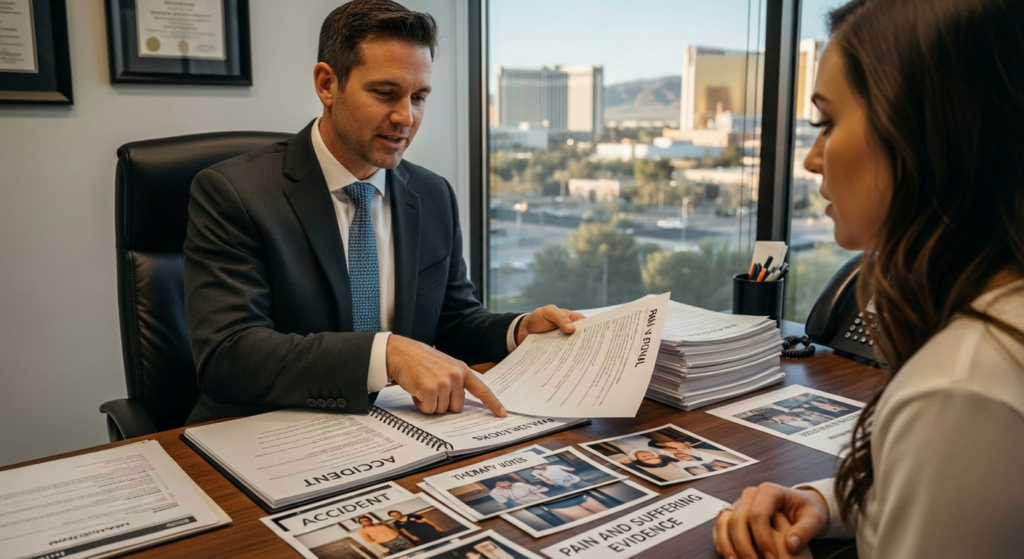
Pain and suffering proof in Nevada injury claim reviewed by attorney with client.
These algorithms are terrible at valuing human suffering. They do not understand that your broken leg stopped you from dancing at your daughter’s wedding. They only see “tibial fracture.” Therefore, you must provide the proof of pain and suffering manually.
Without concrete claim evidence, an adjuster will use the lowest possible number for your damages. Proof forces the adjuster to ignore the machine and look at the human reality of your case. It turns a “soft tissue injury” into a story about a person whose life has been derailed.
Methods of Documenting Your Experience
You are the best historian of your own injury. The most powerful tool you have is your own injury documentation, created in real-time. We strongly advise our clients to keep a detailed record of their recovery.
The Pain Journal
A pain journal is not just a diary; it is vital legal proof. To work, it must be specific. Instead of writing “I hurt today,” write “Sharp, shooting pain in my lower back (level 7/10) kept me from sitting at my desk for more than 15 minutes.”
You should also carefully track your medications. Write down when you take pain relievers and if they help. If you rely on pills often, it proves you are still suffering. Also, record every missed activity. If you skipped a family gathering because the drive hurt too much, write it down. These specific examples create more severe pain and suffering than general complaints.
Visual and Behavioral Evidence
For severe injury cases, we often use visual evidence to connect medical reports to reality. Photos of bruising, swelling, and scarring are essential for documenting injuries. In catastrophic cases, we may produce “Day in the Life” videos.
These videos show a jury or adjuster your daily reality. Watching you struggle for ten minutes just to button a shirt or walk up stairs is strong proof of disability. This type of evidence is difficult for defense attorneys to challenge.
Gathering Strong Claim Evidence
While your journal is subjective, we back it up with objective data from others. Your medical records are the foundation of your claim, but they must be accurate. Doctors are busy and may not write down everything you say.
Medical Consistency
When you see your doctor, be clear about your pain levels and what you cannot do. If you don’t tell them you can’t lift your arm past your shoulder, it won’t be in the notes. Consistency is vital for solid claim evidence. If you tell your physical therapist your back hurts but tell your primary care doctor you feel fine, the insurance company will flag it.
Expert Testimony
We often hire experts to objectively analyze your suffering. Medical experts can testify that your specific injury causes chronic pain. Psychological experts are just as crucial for proving emotional distress.
According to the National Institute of Mental Health (NIMH), symptoms of Post-Traumatic Stress Disorder (PTSD) can include flashbacks, fear of driving, and severe anxiety. If a mental health professional diagnoses you with PTSD from the crash, it validates your trauma as a medical condition, not just “stress.”
The Power of Witness Statements
You are biased in your own favor, but your friends and family are observers. Their testimony is often the “tipping point” in establishing proof of pain and suffering. We interview your spouse, coworkers, and friends to find out who you were before the accident.
A spouse can talk about your restless sleep and mood swings. A coworker can say you used to be energetic but now seem in pain and distracted. A friend can mention that you stopped coming to weekly bowling nights. This outside proof makes it very hard for an adjuster to claim you are lying.
Legal Framework for Pain and Suffering Claims
Nevada law recognizes that an injury affects the whole person, not just their wallet. Generally, there is no cap on non-economic damages in standard personal injury cases, such as car accidents or slip-and-fall accidents. This means a jury can award whatever amount they think is fair based on the evidence.
The Medical Malpractice Exception
However, there is a major exception. In medical malpractice cases, Nevada strictly caps non-economic damages. Under Nevada Revised Statutes (NRS) 41A.035, the amount a plaintiff can recover for pain and suffering is limited, no matter how bad the injury is.
This cap changes annually for inflation, but it is a hard limit on recovery in professional negligence cases. Determining whether your case is general negligence or medical malpractice is critical to your legal strategy.
Social Media Mistakes to Avoid
In the digital age, your own Facebook or Instagram account can be your worst enemy. Insurance investigators will search your social media for evidence that contradicts your injury documentation.
They look for the “Highlight Reel.” If you say you are in crippling pain but post a photo of yourself smiling at a birthday party, they will use it against you. Even if you were in pain while smiling and left ten minutes later, the photo tells a different story. Our advice is simple: set your accounts to private and stop posting until your claim is done. Never discuss your accident or emotional distress online.
Injury Documentation: The Bottom Line
Proving the invisible requires a visible advocate. Insurance adjusters know that victims without lawyers rarely understand the actual value of their suffering. Without comprehensive injury documentation, you risk taking a settlement that barely covers your bills. We build the wall of claim evidence from medical records to witness testimony that forces them to admit the full extent of your loss.
Get Experienced Legal Representation Today
Contact High Stakes Injury Law today for a free consultation, or call (702) 605–6671.
Your pain is real. You deserve to be paid for every sleepless night and missed opportunity. Don’t let an insurance algorithm decide the value of your life.
FAQS: Pain and Suffering in Nevada Legal Claims
How do I prove pain if my X-rays are normal?
Soft-tissue injuries don’t show up on X-rays. You establish pain and suffering proof through consistent physical therapy records, a detailed pain journal, and testimony about your limitations.
Can I get pain and suffering for a minor car accident?
Yes, if you sought medical treatment. Even minor accidents can cause significant disruption and emotional distress, though the value will be lower than in severe cases.
Does seeing a therapist help my legal case?
Absolutely. It provides professional injury documentation regarding your mental health struggles (anxiety, depression, PTSD), which is a key component of non-economic damages.
Will the insurance company spy on me?
In high-value cases, yes. They may use private investigators or social media monitoring to find evidence that contradicts your claims of disability.
Is pain and suffering money taxable?
Generally, no. Compensation for physical injuries and the resulting emotional distress is typically tax-free under IRS rules.
About High Stakes Injury Law
High Stakes Injury Law is a premier personal injury firm dedicated to serving the Las Vegas community and beyond. With a focus on aggressive representation and compassionate client care, we handle cases ranging from complex multi-vehicle pileups to slip-and-fall accidents.
Our goal is simple: to secure the maximum compensation for our clients so they can focus on healing. Our team knows how to translate your personal trauma into the legal claim evidence required to secure a fair settlement.
Scott Poisson, the founder of High Stakes Injury Law, has exclusively represented accident victims since 1993, practicing in Nevada, Arizona, New Mexico, and Florida.