



Property owners often ignore subtle hazards such as worn carpet transitions, poor lighting in stairwells, and “invisible” leaks from refrigeration units. Under Nevada comparative negligence laws, even if a hazard was present, your compensation may be reduced if you are found partially at fault. Nevada follows a “51% Bar Rule,” meaning you can only recover damages if you are 50% or less responsible for the incident.
The Danger Beneath Your Feet
You are walking through a beautifully lit Las Vegas resort, enjoying the atmosphere, when suddenly your feet sweep out from under you. You didn’t see a puddle, a “Caution” sign, or any obvious danger. Most people feel a flash of embarrassment and try to stand up quickly. However, many slip-and-fall accidents are caused by hazards that property owners habitually ignore. These “hidden” dangers, like a slightly loose floor tile or an invisible leak, can change your life in a heartbeat.
Navigating a personal injury claim in these scenarios is more than just proving you fell. It requires a deep understanding of how Nevada comparative negligence impacts your ability to secure accident compensation.
Shared Fault Nevada Law: Key Takeaways
- The 51% Rule is a strict threshold: In Nevada, if a jury finds you 51% at fault for your fall, you are legally barred from recovering any money.
- Hidden hazards are a multi-billion-dollar issue: falls on the same level cost the U.S. economy over $10.5 billion annually in medical and lost-wage costs.
- Immediate documentation is your best defense: Taking photos of the hazard before it is fixed is the most important step in proving a property owner was negligent.
Overview of Comparative Negligence in Nevada
Understanding how fault is shared is the most important part of any personal injury case in the Silver State. It determines how much of your medical bills and lost wages you can recover.
Definition and Importance
Comparative negligence is a legal rule that determines how much a victim can recover based on their own role in the accident. In many slip and fall cases, property owners will try to blame you. They often say you “should have been looking where you were going.” If a jury agrees, they give you a percentage of the fault. This system is helpful because it means you can still get some money even if you weren’t 100% perfect.
Overview of Nevada’s 51% Bar Rule
Nevada uses a “modified negligence” standard known as the 51% Bar Rule (NRS 41.141). This rule says you can recover damages as long as your responsibility for the accident is not greater than the combined negligence of the defendants. According to 2024–2025 Bureau of Labor Statistics data, falls, slips, and trips accounted for 19% of workplace fatalities in Nevada. This shows that these accidents are often much more serious than people realize.
How Liability Percentage Affects Accident Compensation
The amount of money you receive in a settlement is directly tied to the percentage of fault given to each person involved. Even a small change in this number can make a big difference in your recovery.
Calculating Liability in Nevada
Liability isn’t a simple math problem. It is based on evidence. At our practice, we look at whether the property owner did their job to keep the area safe. We ask whether they ignored a known hazard. We also look at what you were doing at the time. Were you looking at your phone, or were you wearing shoes that weren’t safe for the floor? All of these facts go into deciding your final percentage of fault.
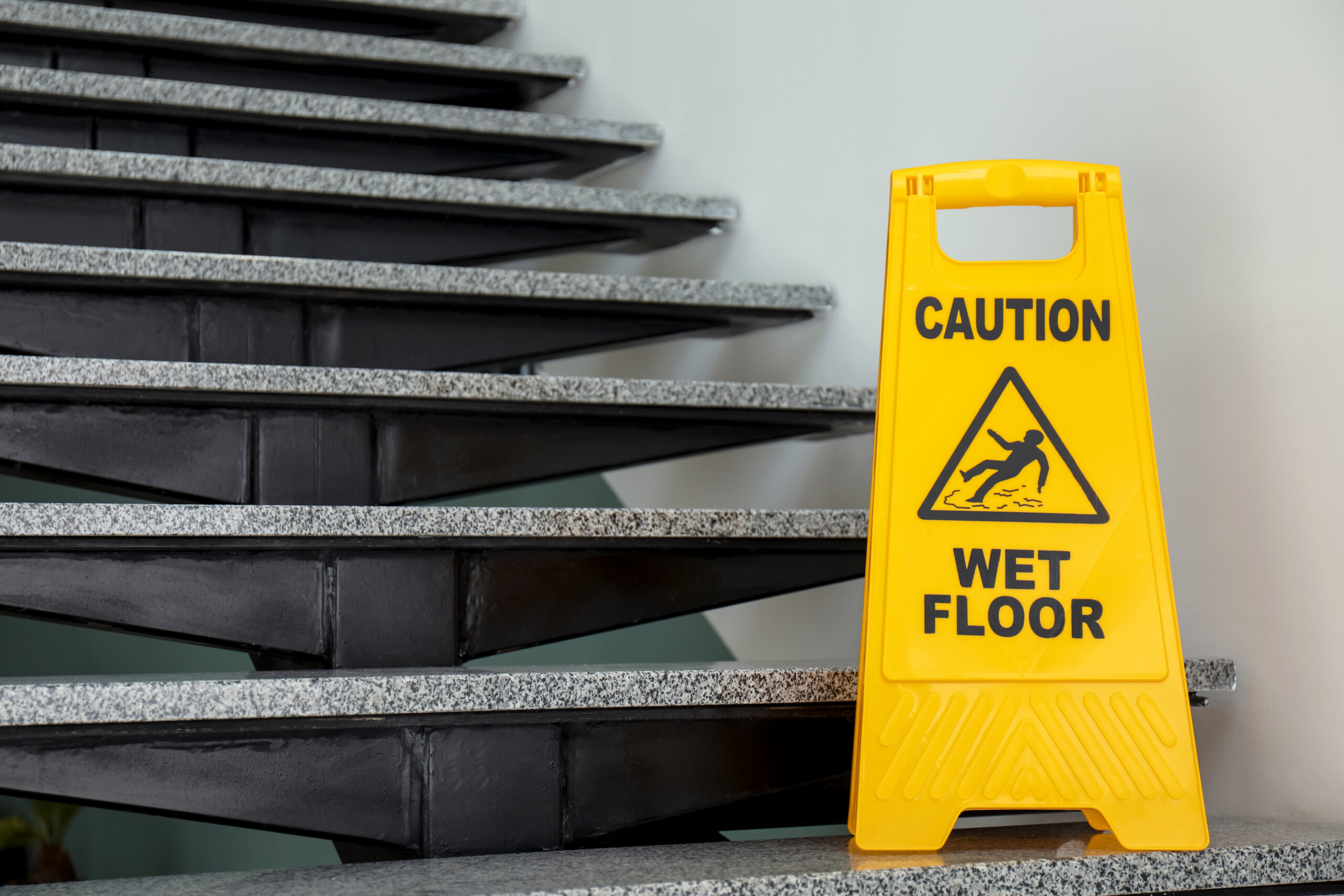
Safety sign warning of a wet floor on the stairway
Examples of Fault Calculation
Imagine you trip over a bunched-up rug in a hotel hallway and have $100,000 in medical bills. If the hotel is 100% at fault, you get the full **$100,000**. If you were looking at your phone, you might be 30% at fault. In that case, you get $70,000. However, if you were running and ignored a warning sign, you might be 60% at fault. In that scenario, you get $0.
The Role of Insurance Companies in Comparative Negligence
Insurance companies use the idea of shared fault in Nevada law to try to pay you as little as possible. They are businesses that want to protect their profits.
Common Insurance Tactics to Reduce Payouts
Insurance adjusters are trained to find ways to make you look like you were at fault. They might ask for a recorded statement and try to trick you into saying you were distracted. They might even look at your social media to see if you are active after the accident. Their goal is to shift the blame to you, raising your share to 51%. If they succeed, they do not have to pay you anything at all.
Understanding How Liability Influences Settlement Offers
Most Nevada auto accident settlements and slip-and-fall cases never go to a courtroom. Instead, the insurance company offers a “settlement value” based on what it thinks a jury would award. If they believe they can convince a jury you are 40% at fault, they will take 40% off their offer from the very beginning. This is why having a strong lawyer is so important to protect your rights.
Navigating Nevada Auto Accident Settlements
While this guide focuses on slip-and-fall cases, the same rules for modified negligence apply to Nevada auto accident settlements. The process of proving fault remains largely the same.
Effective Strategies for Maximizing Your Claim Value
To fight against being blamed, you need to build a strong case right away. This means reporting the accident to the property manager immediately and seeking expert help. We often hire “human factors” experts who can explain to a jury why a hidden hazard was impossible for you to see. We work tirelessly to make sure the facts are clear. This helps prevent you from being unfairly blamed for someone else’s mistake.
Importance of Gathering Evidence and Documentation
Evidence is the only thing that can change the percentage of fault. You should take photos and videos of the hazard from multiple angles before it is cleaned up. Recent data from the National Safety Council shows that lighting and messy floors can be causes of these injuries. Documenting these specific problems is the best way to prove your claim. It creates a clear record that the insurance company cannot easily ignore.
Hidden Hazards: The $10 Billion Problem
New data from the 2025 Liberty Mutual Workplace Safety Index shows that falls on the same level cost U.S. businesses more than $10.5 billion each year. This makes it one of the most expensive types of injuries in states like Nevada. This is especially true for the service and hospitality industry.
Lighting and Maintenance Failures
A floor that looks safe during the day can be a trap at night. Poor lighting often hides floor bumps or spills. This is very common in parking lots or stairwells. We often find that a “hidden” leak was reported weeks before an accident, but was never fixed. This shows that the property owner was being very careless with your safety.
Speak with a Nevada Personal Injury Lawyer
If you have been hurt, do not let an insurance company tell you it was your fault.
Contact High Stakes Injury Law today for a free consultation to discuss your rights and begin your path to recovery – virtually or in-person. Call (702)-256-4566
Our attorneys know how to identify hidden hazards and fight for the maximum possible compensation in accident cases. You deserve a legal team that truly cares about your future.
Nevada Comparative Negligence: Bottom Line
The bottom line is that Nevada’s 51% rule makes it very important to prove who was really at fault. By learning how property owners ignore hidden risks and how insurance companies use modified negligence laws, you can protect your right to get the money you need. At High Stakes Injury Law, we are here to give you the clear and honest legal support you need. We want to help you get your life back on track after a serious injury.
Nevada Comparative Negligence: FAQ
Many people have frequently asked questions about how Nevada comparative negligence works after an accident.
- What happens if I am found 50% at fault in Nevada? If you are exactly 50% at fault, you can still get 50% of the money for your damages. You only lose the right to get money if you are 51% or more at fault.
- Does comparative negligence apply to car accidents, too? Yes. The same rules for modified negligence apply to Nevada auto accident settlements to decide how much money you can receive.
- Can I still sue if there was a “Caution” sign? Yes. A sign does not mean a property owner can be careless. If the sign was hard to see or if the hazard was too dangerous for just a sign, you may still have a case.
- How is the “liability percentage” decided? Fault is determined by considering all the evidence. This includes what witnesses saw, security camera footage, and building maintenance records.
- How long do I have to file a claim in Nevada? In most cases, you have two years to file a personal injury claim in Nevada. It is best to talk to a lawyer right away so you do not lose any important evidence.
About High Stakes Injury Law
For many years, High Stakes Injury Law has been a trusted part of the Nevada community. Our founder, Scott Poisson, has been helping accident victims since 1993. He has practiced law in Nevada, Arizona, New Mexico, and Florida. This wide range of experience helps us build a strong case for you, backed by data and facts. To learn more about how we help our neighbors, visit our About Us page.